 |
| Photo by Frédéric Salein. June 23, 2010 |
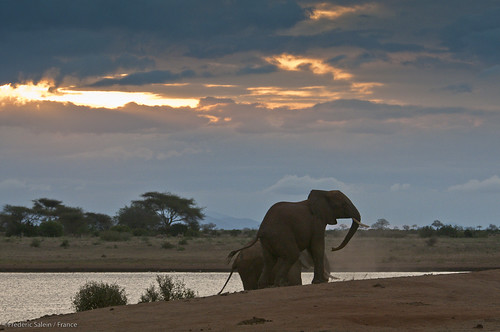
Does a country’s jurisdiction extend to the diet of the animals within its boundaries? To save the acacia woodland of southern Zimbabwe, it might have to. A study conducted in Northern Gonarezhou Park in Zimbabwe observed the impact of the eating habits of elephants’ upon woodlands composed of Acacia tortilis trees. Through careful measurement of over 800 different plants, the study determined that the A. tortilis woodland was gradually being transformed into open woodland by the elephants, and recommended a program of long-term observation and conservation for sensitive, at-risk areas.
As the largest land mammals on Earth, elephants are often the subject of our wonder, our fascination, and sometimes our greed. In the summer movie Water for Elephants, Reese Witherspoon plays a circus performer who makes her living riding atop an elephant-- an elephant who is beaten and abused by the ringleader with his lust for power and money. The intended effect is that the audience comes to sympathize with the elephant, which is in itself interesting; these are creatures who, it has been demonstrated, have the capacity for long-term memory far exceeding a human’s and, like us, hold quite an influence over their environment. So when a study is published which takes a look at the elephant in its natural habitat, and its impact on the ecosystem, it is an attention-grabber.
 |
| Three acacias - Photo by Martin Sharman. Dec. 18, 2006 |
From the data analysis, the picture became clear: mean tree height, mean basal area, and mean tree density were all significantly higher in the lower utilization zones. Furthermore, there was a greater diversity of woody species in these areas. Across the board, the acacia woodland in the lower utilization zones, the zones least frequented by elephants, was healthier and more prosperous. The findings support the hypothesis that elephants impose a large influence on the vegetation of their arid and semi-arid climates, mainly by debarking in the dry season. Observations show that during critical dry periods in the savanna, the elephant is more likely to come to the A. tortilis tree than any other tree. (Owen-Smith, 1988). Largely through the elephant’s efforts, the woodland patches in the Gonarezhou savanna are being transformed and its most important tree being wiped out.
Or is it? The results, while cause to worry, are not exactly a sure thing. There are other factors which hold influence on the life cycle of an acacia woodland: drought, disease, fire, soil conditions, topography, and past human activities. Elephants certainly do not hold all the blame when a woodland is stripped of its acacia’s. Moreover, the results could have been affected by the fact that only a single round of sampling was conducted. This phenomenon could be temporal and fleeting... or it could be even worse than previously suggested. With such limited data it is hard to know. The researchers conclude by making two recommendations: establishing thresholds beyond which action will be taken to protect the ecologically important A. tortilis, and continuing long term evaluation of the interaction between large herbivores and their choice of vegetables.
Matt Hugo
Gandiwa, E. E., Magwati, T. T., Zisadza, P. P., Chinuwo, T. T., & Tafangenyasha, C. C. (2011). The impact of African elephants on Acacia tortilis woodland in northern Gonarezhou National Park, Zimbabwe. Journal of Arid Environments, 75(9), 809-814. doi:10.1016/j.jaridenv.2011.04.017
J.J. Midgley and W.J. Bond, A synthesis of the demography of African acacias. Journal of Tropical Ecology, 17 (2001), pp. 871–886.
R.N. Owen-Smith, Megaherbivores: The influence of very large body size on ecology, Cambridge University Press, Cambridge (1988).

No comments:
Post a Comment